
Wireless Earbuds, Bluetooth 5.4 Headphones In Ear with Charging Case, 48H Playtime Bluetooth Ear
£5.99
View on Amazon →
Published 16 September 2026 · updated 2026-09-16 · by OwnShop UK
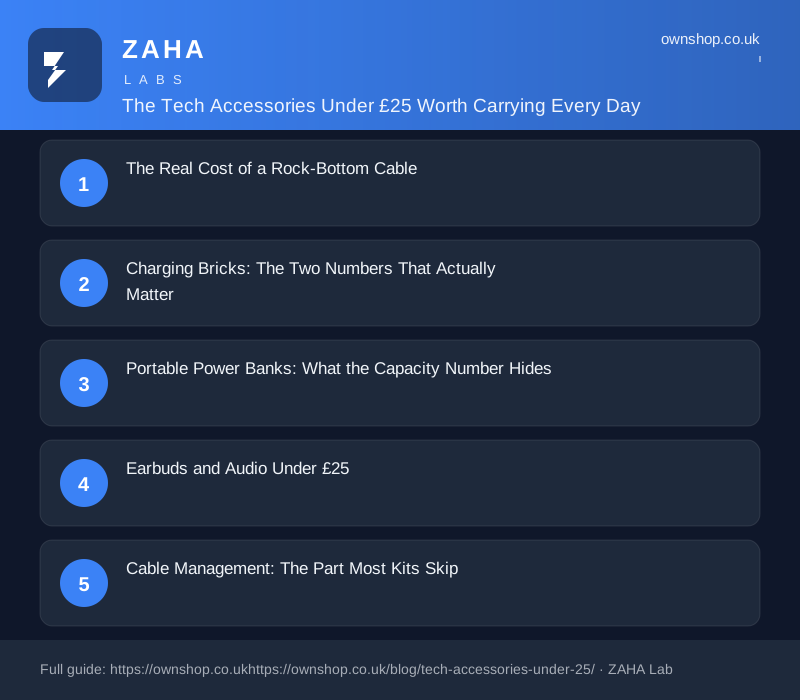
Spend £1.50 on a USB-C cable and there is a real chance it damages your phone's charging port — not because the cable snaps, but because undersized internal conductors allow incorrect current levels from day one. The best tech accessories under £25 are genuinely worth buying; the key is knowing which three or four specs to check before you do.
The difference between a problematic cheap cable and a reliable one is not visible from the outside. Many budget cables use copper conductors that are thinner than the USB standard specifies for their rated current. The wire heats up, the insulation degrades from the inside out, and you get intermittent connection drops before the cable fails entirely — often within six months of daily use.
The other failure point is the connector itself. Every time you plug and unplug a cable, the joint between the cable body and the connector takes mechanical stress. Cables with a reinforced strain relief — a stiffened collar that prevents the cable bending at a sharp angle right at the plug — last significantly longer. Look for braided or TPE-sleeved cables; they resist kinking when repeatedly compressed in a bag and survive the twist-and-pack cycle far better than smooth PVC cables.
The USB-C connector is the same physical shape regardless of what a cable can actually do. A cable not built to USB Power Delivery (USB-PD) spec may deliver only 5W even when connected to a 65W charger — fine for slow overnight charging, a real problem if you need a meaningful top-up quickly. More critically, non-compliant cables can occasionally allow voltage levels through that the USB-PD standard is specifically designed to prevent, via an embedded controller chip that verifies the connection before current flows. Look for USB-IF certification or USB-PD 3.0 compliance stated explicitly in the product listing, not buried in marketing copy.
Cables labelled "fast charging" or "super speed" with no certification reference are a reliable red flag. Genuine fast-charge capability requires certified components — not marketing language. If a listing does not reference USB-IF, USB-PD or a recognisable standards body, treat any speed claim as unverified. The cable may charge at a basic 5W rate regardless of what your charger and phone are capable of, and you may never know.
A charger's headline wattage only helps up to your device's maximum accepted input. Most current Android phones accept between 18W and 45W depending on the manufacturer's fast-charge implementation; most iPhones top out at 20W; laptops vary significantly. Buying a 65W GaN charger primarily for a phone that accepts 20W will not charge it faster — but that same brick can top up a laptop when you need it, making it genuinely multi-purpose and often worth a few extra pounds at the point of purchase.
Gallium nitride (GaN) chargers run significantly cooler than equivalently rated silicon chargers and are considerably smaller for the same output. Under £25 you can now find single-port GaN bricks at 20–30W that are barely larger than a 50p coin, and dual-port GaN versions at 35W total. The cooler operation is not just a comfort difference — sustained high temperatures inside a charger degrade capacitors and other components over time, so a GaN charger generally has a longer useful life than its silicon equivalent.
When buying multi-port chargers, always check the per-port wattage when all ports are in use simultaneously, not just the headline total. A 35W dual-port charger might deliver 20W on USB-C and 15W on USB-A at the same time, or it might split less usefully. This information should be in the spec sheet, not the marketing headline.
Some chargers automatically shift power to whichever port needs it most, rather than giving each a fixed share regardless of what is plugged in. This feature — sometimes called intelligent power sharing — is particularly useful if you regularly charge two devices at once. It means the charger adapts to your actual load rather than halving its output whether one or both ports are in use.
The headline capacity of a power bank in milliamp-hours (mAh) is consistently less informative than it appears. Internal conversion losses — the energy used by the bank's own circuitry stepping voltage up to the output — mean you typically receive around 60–70% of the stated figure at the device end. A 10,000mAh bank realistically delivers around 6,000–7,000mAh to a phone, which is enough for one to two full charges depending on your handset.
For daily carry, the more useful questions are about speed and form factor, not raw capacity:
| Spec | What to look for | Why it matters |
|---|---|---|
| Capacity | 5,000–10,000mAh for daily carry | Balances charge cycles against weight and bulk |
| USB-C output | 18W minimum | Fast-charges modern phones and wireless earbuds |
| Input speed | 18W+ | Refills overnight rather than over a full day |
| Cell type | Lithium polymer preferred | Slimmer and lighter than cylindrical cells at the same rating |
| Pass-through | Listed explicitly if supported | Charge device and bank together from one socket |
| Safety marks | CE marked | Minimum verification of UK safety compliance |
Budget in-ear buds have improved considerably in recent years. The limiting factor at this price is less often driver quality — most budget earbuds now produce broadly acceptable audio — and more often fit. A poor fit allows ambient noise in, you raise the volume to compensate, and listening fatigue arrives much faster.
Look for earbuds that ship with at least three ear tip sizes (S/M/L). Silicone tips are more consistent across different ear canal shapes than foam if you are buying without trying first. Bluetooth 5.0 or later is standard at this price and is entirely sufficient — the practical difference between 5.0 and 5.3 for audio at arm's length is negligible.
Expect four to six hours of playback from the buds themselves and an additional twelve to twenty hours from the charging case. If you use earbuds regularly on calls, check whether the listing mentions dedicated microphone noise reduction — sometimes described as CVC (Clear Voice Capture) or similar. It makes a meaningful difference in wind or busy indoor environments and is not universally present at this price.
Wired earbuds remain worth considering at this budget. They have no battery to manage, pair instantly with any device, and because there is no Bluetooth compression involved the audio quality ceiling can be higher than wireless equivalents. The trade-offs are a cable to manage and no compatibility with phones that have removed the 3.5mm jack.
Loose cables in a bag are how cables die early. Braid frays where the cable rubs against keys and chargers; connectors take repeated small impacts. The fix costs almost nothing and adds negligible weight.
Short cable options — 30cm to 50cm — are worth having specifically for bag use, where you are often plugging directly into a battery pack rather than a wall socket several metres away. Full 2m cables are comfortable at a desk but unnecessary weight on the move and tangle more readily in a small bag.
Reusable magnetic cable ties keep cables neatly coiled without the lint problem velcro straps develop over time. A small zip-up cable pouch keeps connectors from snagging on bag linings and means everything is in one place when you actually need it.
Before adding any sub-£25 tech accessory to your basket, a thirty-second scan of the listing covers most bases:
Cables
Charging bricks
Power banks
Earbuds


Check the product listing for USB-IF certification or USB-PD 3.0 compliance — these indicate the cable meets minimum safety standards for the current it carries. Look for reinforced strain relief at the connectors, which signals better overall build quality. If a listing only says "fast charging" with no certification reference and the price is very low, treat the claim with caution. Verified buyer reviews mentioning durability are a useful secondary check when specs are unclear.
For most people, yes — particularly if you carry a charger in a bag or use one at a desk for hours daily. GaN chargers run noticeably cooler than silicon equivalents at the same wattage, which generally extends their lifespan, and they are significantly smaller and lighter. The price premium has narrowed considerably in recent years; 20–30W GaN bricks are now available well under £20 and are smaller than many phone chargers from five years ago.
A well-made power bank should retain meaningful capacity through several hundred full charge cycles — typically two to three years of regular daily carry use. Heat and storing the bank at very high charge for extended periods both accelerate degradation. Partial charges are easier on lithium cells than repeatedly draining to zero. Banks with a percentage indicator help you avoid deep discharge before recharging, which is the single most damaging pattern for battery longevity.
The earbuds themselves are not the risk — the volume level is. A poor fit lets in background noise, which pushes you to raise the volume to compensate, and sustained high volume causes gradual hearing damage over time. Earbuds that seal well enough to passively reduce ambient noise let you listen at lower levels on a noisy commute. Most budget earbuds include multiple tip sizes precisely because fit matters; try the smallest that stays in place comfortably.
As an Amazon Associate we earn from qualifying purchases. Prices and availability are accurate as of the date shown and are subject to change — the price on Amazon at checkout is the one that applies.

The kitchen storage UK shoppers are buying this month — with capacity checks, size traps, and measuring tips that stop you orderin
The best tech accessories under £25 for UK shoppers — cables, chargers, earbuds and power banks that hold up, and what specs to ch