
Kitsure Large Cutlery Tray Drawer Organiser, Adjustable Kitchen Accessories | 5 Compartments, Id
£14.44
View on Amazon →
Published 16 September 2026 · updated 2026-09-16 · by OwnShop UK
The average UK kitchen stores more in the first 30 cm of each cupboard than in the full depth behind it — because the back half is simply unreachable. This month, the best kitchen storage falls into three categories: stackable airtight canisters, under-sink pull-out organisers, and drawer dividers that press-fit without measuring tape prayer.
Three product types dominate kitchen storage searches across UK shoppers this month: stackable food canisters, under-sink pull-out organisers, and bamboo drawer dividers. The shift is consistent — people replacing a random collection of mismatched containers with systems where everything sits at the same height and is visible at a glance.
The frustration this solves is straightforward. When containers stack unevenly, the tallest end up at the front, blocking everything behind. When under-sink space is unstructured, bottles topple and every reach for the drain cleaner turns into an excavation. Modular, matching storage solves both at once.
Before you add anything to your basket, measure three things: interior cabinet width, interior cabinet depth, and available height between shelves. These are almost never the same as the furniture's external dimensions.
Cabinets typically lose 3–4 cm on each side to frame and hinge hardware. A 60 cm base cabinet often has only 52–54 cm of usable interior width. Storage organisers labelled for 'standard' cabinets can fail to fit without this check.
If you're buying containers to stand upright, measure the actual air gap between the top of one shelf and the underside of the shelf above — not the nominal shelf setting. Shelf clips can sit at non-standard heights depending on how a previous owner configured the cabinet.
Under-sink space is awkward because the waste pipe and supply connections eat into usable depth and often sit asymmetrically. Measure depth on both sides of the pipe run separately. That tells you which side can take a deep pull-out organiser and which side is better suited to a slim stackable caddy.
Container labels almost always quote brim-full volume. In everyday use, practical fill capacity runs at 70–80% of the stated figure — a '5-litre' canister holds roughly 3.5–4 litres of pasta or rice once you account for comfortable pouring and headspace. Buy one size larger than you think you need for anything you store in volume.
For dry goods — flour, rice, oats, pasta, coffee, tea, spices — seal quality matters more than appearance. Look for a silicone gasket around the lid rim. Clip-lock lids (the metal bail-and-rubber-seal type) outperform push-top lids for long-term airtightness; push tops are fine for items you cycle through quickly, like daily-use coffee or tea.
| Item | Approx weight per litre | Practical container size |
|---|---|---|
| Plain flour | ~600 g/litre | 3–5 litres for a 1.5 kg bag |
| Short pasta | ~550 g/litre | 2–3 litres for a 500 g pack |
| Rolled oats | ~350 g/litre | 3–4 litres for a 500 g pack |
| Ground coffee | ~300 g/litre | 1–1.5 litres for a 250 g pack |
| White rice | ~800 g/litre | 2–2.5 litres for a 1 kg bag |
| Loose-leaf tea | ~150 g/litre | 1 litre for 100 g |
Use these to avoid the common mistake of buying a container that holds only half a bag — leaving the rest in a clip-sealed packet on the shelf beside it, which defeats the whole point.
Flat-lid containers stack cleanly; domed or curved lids do not. If vertical space is limited, look for sets where the base of one container is designed to seat into the lid of the one below. Modular sets that stack will usually say so and show it in the product photography — check for a side-on stacking shot before buying.
Before committing to any storage layout, think through what you reach for most often. If it's the coffee, it needs to be at the front. If it's cooking oil, the new organiser should sit where you naturally reach. Storage that looks tidy in photos but lives somewhere inconvenient will be moved or quietly tolerated — both defeat the purpose.
Most under-sink cupboards are a single large void interrupted by plumbing. Three approaches genuinely help:
Tension shelves press between the cabinet sides and adjust around pipes without drilling — useful in rented kitchens or where you want no permanent fixtures. They create a half-height layer that is otherwise completely wasted dead space.
Pull-out organisers slide forward on runners, bringing the full depth of the cabinet into reach. Most need 30–35 cm of clear depth to travel and open fully. Measure your pipe clearance before ordering — pipe obstruction is the most common reason under-sink organisers get returned.
Stackable bins and caddies work best on the side of the cabinet away from the main waste pipe, where the floor area is more regular. Look for handles rather than smooth sides so you can pull the whole bin clear without rummaging through it in situ.
For under-sink use, plastic is more practical than bamboo or untreated wood. Humidity from pipes and occasional drips will warp wood faster here than anywhere else in the kitchen.
Kitchen drawers split into two practical types: shallow cutlery drawers (typically 5–8 cm deep) and deeper utensil drawers (typically 10–15 cm deep). The best divider system for each is different.
For cutlery drawers, modular inserts that tile together give more flexibility than a single-piece tray. A single tray is unlikely to match the exact dimension of your drawer; tiling inserts can be arranged to leave only a small gap at one edge rather than sitting loose and rattling every time the drawer opens.
For deeper utensil drawers, adjustable-width bamboo dividers expand to press-fit against the drawer sides. Most expand across two ranges — roughly 27–37 cm and 37–55 cm — so check which range your drawer interior width falls into before buying.
Angled inserts that tilt jars toward you so you can read the labels are significantly more useful than flat inserts. Standard spice jar diameters are typically 40 mm (small jars) and 53 mm (standard sauce and preserve jars). Check the diameter of your current jars before buying inserts sized for one or the other — the difference is obvious once a jar won't sit flush.
A dedicated pantry cupboard is easy to organise badly. The two main mistakes are using only one shelf level and ignoring the door.
Tiered shelf risers turn a single shelf into two or three visible rows. They work best for tins, jars, and squat bottles where everything at the back would otherwise be hidden. Look for steel or rigid plastic construction over wire — wire risers look neat but tend to be unstable under heavy tins and shift position over time.
Turntables (lazy Susans) bring corner or deep-shelf items forward with a single spin. A 25 cm turntable fits most standard shelf depths. Check that the shelf is at least 3–4 cm wider than the turntable so it can rotate without catching the cabinet frame — a turntable that catches is immediately abandoned.
Door-mount organisers add storage without claiming any shelf space. They suit spice racks, cling film and foil dispensers, and small packet goods well. Measure the clearance between the closed door and the nearest shelf inside before buying — most door-mounted solutions need at least 5–8 cm of swing clearance to avoid hitting shelf contents when the door closes.
Run through these before confirming any kitchen storage purchase:


For a 1.5 kg bag of plain flour, look for a canister with at least 3.5–4 litres of nominal stated capacity. Flour runs at around 600 g per litre brim-full, but practical fill is closer to 75–80% of the stated volume, so a '3-litre' canister holds roughly 2.2 litres comfortably. A 4–5 litre container lets you decant the full bag without forcing the lid. Clip-lock lids with a silicone gasket keep flour driest between bakes.
Start by measuring usable depth on each side of the waste pipe separately — they're rarely equal. The deeper side suits a pull-out organiser or tall stackable caddy; the shallower side works for slim bins or a tension shelf fitted above the pipe run. Avoid anything labelled 'standard under-sink' without checking the depth first — most pull-outs need at least 30 cm of clear travel to open fully. Plastic construction handles the moisture in this space better than wood or bamboo.
Bamboo holds up well in dry locations — drawer dividers, shelf inserts, and countertop organisers stay in good shape for years with normal use. The risk is moisture: spaces near the sink, under the sink, or beside a constantly steaming kettle shorten bamboo's life noticeably. For those spots, choose plastic instead. In a standard dry drawer or on a pantry shelf, bamboo is a practical, non-slip material that tends to look good longer than printed plastic and doesn't scratch other surfaces.
Clip-lock canisters use a metal bail arm that clamps a rubber seal against the lid, creating consistent pressure that keeps moisture and air out. Push-top (or press-on) lids seal by friction alone — fine for items used daily, but they lose their seal faster and are not reliably airtight for long-term storage. If you are decanting staples you want fresh for months — flour, rice, oats — choose clip-lock. Push-top works well for coffee or tea that you will finish within a few weeks.
As an Amazon Associate we earn from qualifying purchases. Prices and availability are accurate as of the date shown and are subject to change — the price on Amazon at checkout is the one that applies.
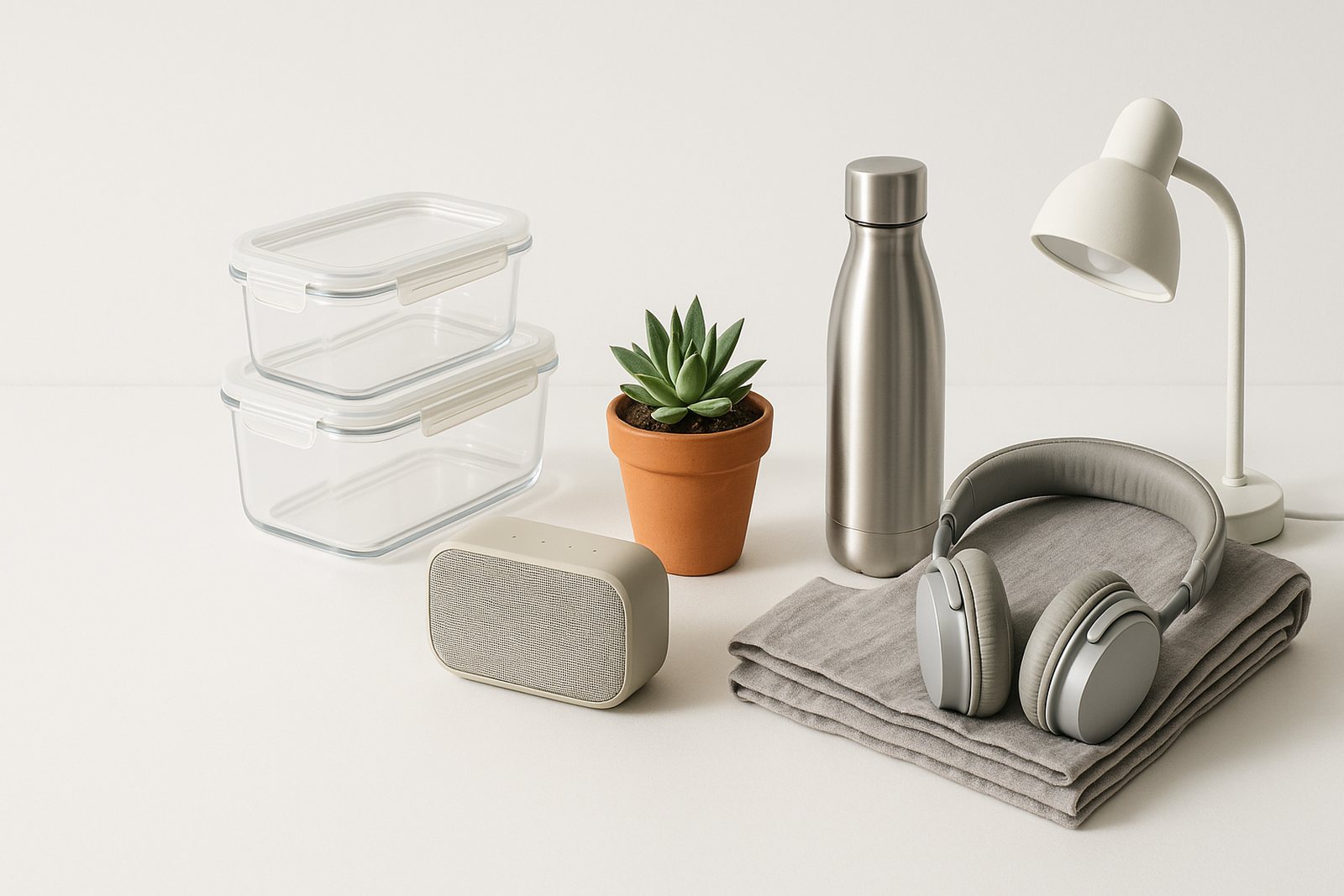
The kitchen storage UK shoppers are buying this month — with capacity checks, size traps, and measuring tips that stop you orderin
The best tech accessories under £25 for UK shoppers — cables, chargers, earbuds and power banks that hold up, and what specs to ch